


From the road there is nothing to see: a forest, a few concrete domes in a clearing, a modest visitor centre. But between 1963 and 1978 this corner of Samogitia hid four Soviet ballistic missiles, each carrying a thermonuclear warhead, aimed at cities in Western Europe. Today the base at Plokštinė is the Cold War Museum, and a day trip there – combined with Lake Plateliai and the strangest garden in Lithuania – is one of the most memorable things you can do from Klaipėda.
Distance: about 76 km from Bohema, 1 h 20 min by car.
Tickets (2026): €12 adults, €6 pupils, students and pensioners; audio guide €4.
Tours: May–September every hour from 10:00 to 18:00; October–April at 10:00, 12:00, 14:00 and 16:00.
Booking: register by phone, +370 677 86 574 – especially if you want an English-speaking guide.
The secret base at Plokštinė
Construction began in 1960, when thousands of soldiers started digging into the forest near Lake Plateliai. By the end of 1962 the USSR's first underground launch complex for R-12 missiles – NATO called them SS-4 Sandal – was on combat duty. Four missiles stood in four silos about 30 metres deep, each covered by a heavy concrete dome that slid aside on rails before a launch. Each warhead had a yield of two megatons.
About 300 soldiers lived in a military town half a kilometre from the silos, with their own pig farm and drinking water piped from Lake Plateliai. The base was closed on 18 June 1978. From 1979 a Soviet Pioneer children's camp occupied the barracks, and in 1993 the territory passed to Žemaitija National Park. The museum opened in 2012 – according to the park, the only exhibition in Europe set inside one of the first Soviet underground ballistic-missile complexes.
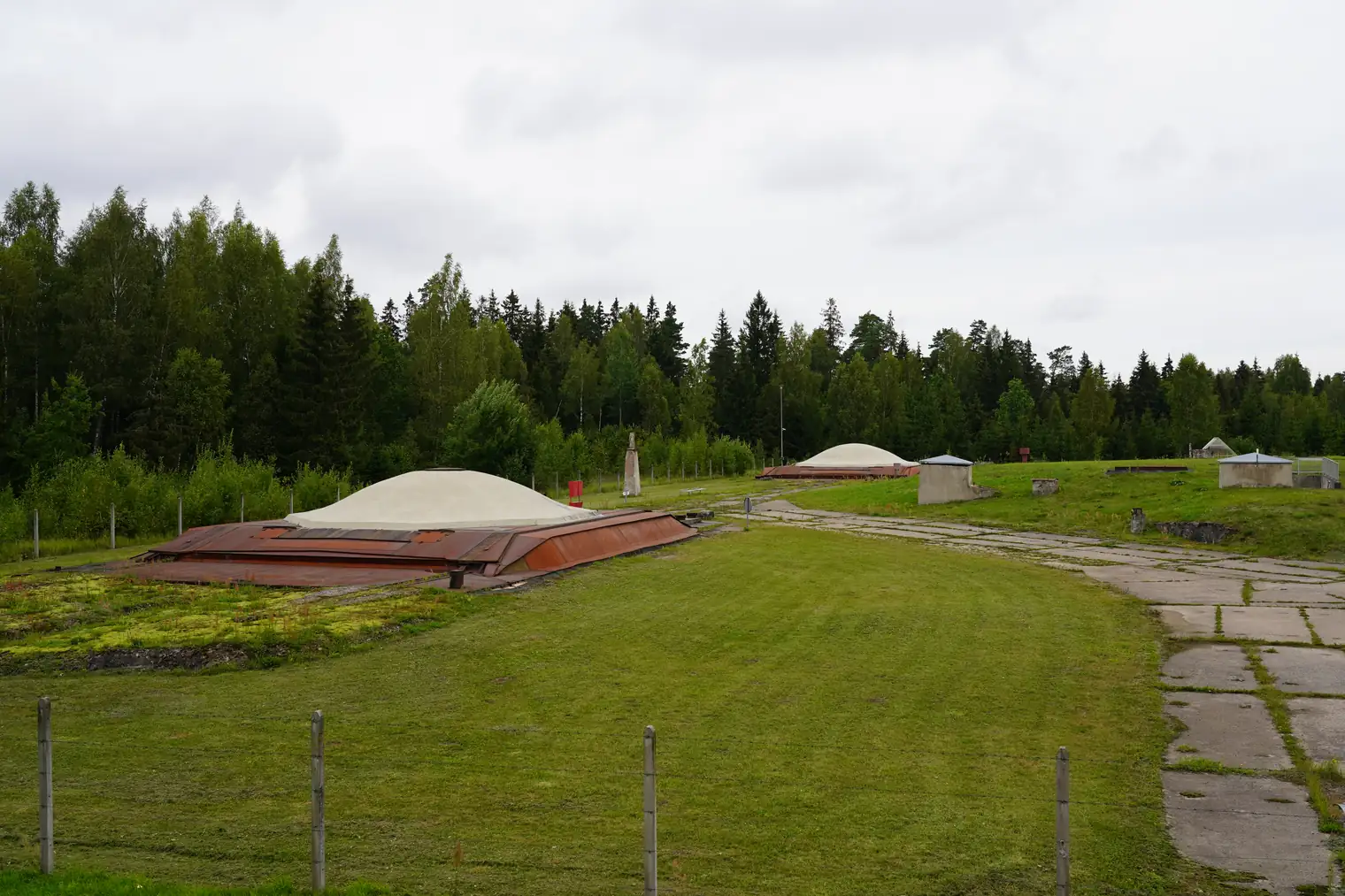
What you see on the tour
Visits are guided and take about an hour. The route leads underground through the restored command room, a hall on the history of the Cold War from the Second World War to disarmament, and a hall of missile technology with real components and the only exact model of an SS-4. Behind glass sits the base commander – a colonel with his finger on the button. A launch needed two officers turning two keys at almost the same moment.
Then a narrow corridor brings you to the edge of a silo. You look down into a concrete shaft almost 30 metres deep where a combat-ready missile stood for nearly two decades. Few museum moments in Lithuania are as quiet as this one. Outside, a reconstructed section of the base's multi-layer electronic security fence shows how closely the site was guarded, and since 2025 information boards and QR-code audio guides lead you around the remains of the military town.
Practical information
- Opening hours: May–September daily 10:00–19:00, October–April daily 10:00–17:00. Closed on 1 January, Easter Sunday and Monday, 1–2 November and 24–26 December. Tickets are not sold in the last 30 minutes.
- Tours: up to 40 people each; tickets are for a specific time, so if a tour is full you join the next one. Guides speak Lithuanian, English and Russian; audio guides are also available in German.
- Booking: the museum asks visitors to register in advance by phone (+370 677 86 574). Groups of more than ten must book. Tickets are sold only at the desk on site, and cards are preferred.
- Good to know: the underground part is not accessible by wheelchair, prams, bikes and pets are not allowed inside, and a warm layer is welcome in the bunker even in summer.
- After dark: in the off-season the museum also runs flashlight tours of the base's hidden corners for adults and an escape game – dates and prices are on zemaitijosnp.lt.
The whole day on one map
This loop starts and ends at Bohema and covers about 200 km – roughly three and a half hours of driving, so plan a full day. The times under each stop are by car straight from the hotel.
- Google MapsApple MapsWazeWebsite
- Google MapsApple MapsWazeWebsite
- Google MapsApple MapsWazeWebsite
- Google MapsApple MapsWaze
- Google MapsApple MapsWazeWebsite
Plateliai and its lake
Ten minutes from the missile base, the small town of Plateliai sits on the shore of the largest and deepest lake in Samogitia. In 2025 UN Tourism named it one of the world's Best Tourism Villages – the first in Lithuania. It is the headquarters of Žemaitija National Park, and a lovely place to slow down after the bunker.
The manor and the Shrovetide masks
The French counts de Choiseul-Gouffier owned Plateliai manor from the end of the 18th century until 1940. Their wooden palace burnt down in 1943, but the outbuildings survive. The old stable now holds the first museum of Užgavėnės, the Lithuanian Shrovetide carnival, with more than 300 masks of devils, witches, beggars and goats – Plateliai is famous for its carnival. The granary houses the national park exhibition. One ticket (€6) covers both; they are open Tuesday to Saturday, and on Sundays too in June–August.
In the manor park stands the Witch's Ash, the thickest ash tree in Lithuania, 7.56 m around. Legend says a witch threw a stolen loaf at it, which is how it got its great burl – and that witches still gather beneath it before flying off to Šatrija hill. Nearby is the wooden Church of Sts Peter and Paul, built in 1744.
Lake Plateliai
The lake covers 1,205 hectares, is almost 50 metres deep and has seven islands. On Castle Island a castle of the Lithuanian dukes stood in the 15th century, once linked to the shore by a wooden bridge whose piles still lie under the water.
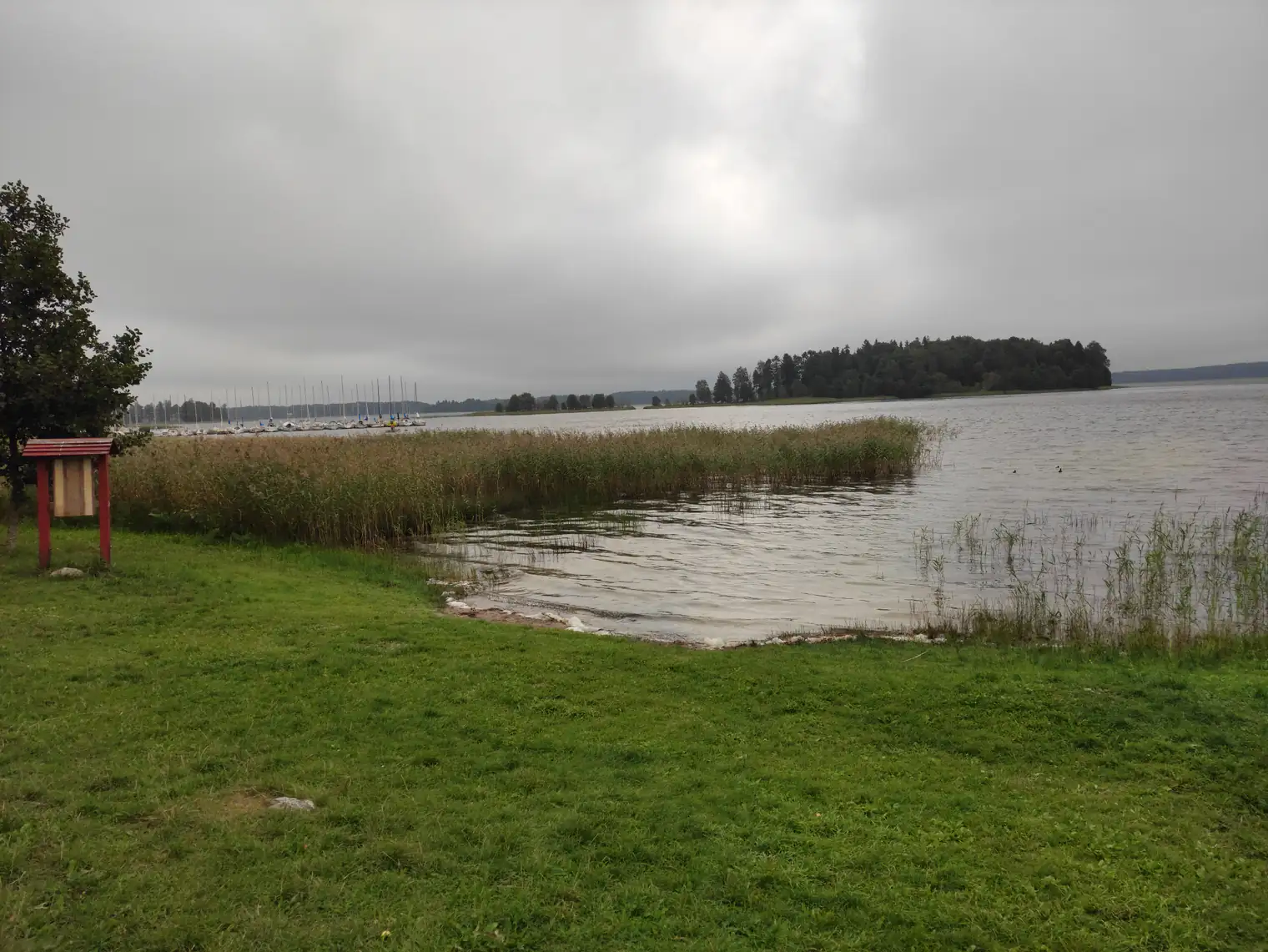
The name comes from a legend: a dark cloud hung over the meadows for three days until an old woman cried “Kāp platē lėij!” – “How wide it pours!” – and the cloud fell down as a lake. From the viewpoint at the north-east edge of town, boards tell this and the other island legends. In summer, families swim at the shallow sandy beach at Paplatelė.
Short walks
- Plokštinė trail – 3 km through the forest of the former base to Pilelis spring, which never dries up or freezes.
- Šeirė trail – 4.1 km past a bog, a small lake and the shore of Lake Plateliai; 1.4 km is adapted for wheelchairs.
- Around the lake by bike – a 24 km loop that passes the Cold War Museum.
The national park asks visitors to buy a €1 day ticket, which pays for trails and benches – at the visitor centre in Plateliai or by texting “ZNP” to 1860.
Orvidas Homestead: a garden of rescued stones
Near Salantai, about an hour's drive from Klaipėda, the stonemason Vilius Orvidas (1952–1992) spent twenty years saving what Soviet land reclamation was about to destroy: huge boulders, old tree stumps, millstones and farm tools. He turned them into a labyrinth of sculptures, crosses and shrines, where Catholic, pagan and Buddhist symbols sit side by side – and even an old tank. The Soviet authorities tried to stop him; today his homestead is a museum, and seen from the air it forms a triangle, the Eye of Providence.
Tickets cost €8 for adults. The homestead is closed from December to February and opens only on certain weekdays in spring and autumn, so check the calendar on orvidusodyba.lt or call ahead. Pets are not allowed, and the place asks for quiet.
Žemaičių Kalvarija and Mosėdis
If you still have time, Žemaičių Kalvarija is 20 minutes north-east of Plateliai. In the 1630s Bishop Jurgis Tiškevičius founded the first Way of the Cross in the Grand Duchy of Lithuania here, with about twenty stations in chapels scattered over the hills. The church has been a minor basilica since 1988, and in early July (usually 1–12 July) tens of thousands of pilgrims arrive for the great feast – a moving sight, but expect crowds and traffic.
To the north-west, in Mosėdis, the doctor Vaclovas Intas began collecting glacial boulders in the late 1950s – he carried the first one home on his bicycle. His collection grew into the Stone Museum, a valley of boulders and a restored watermill. Tickets cost €4; from October it is open Tuesday to Saturday, 9:00–18:00.
Suggested itinerary (summer)
- 08:30 Leave Bohema and drive to Orvidas Homestead (about 1 hour).
- 09:45 Walk among the stones for 45–60 minutes.
- 11:00 Cold War Museum – the 11:00 or 12:00 tour, then the Plokštinė trail if you have the energy.
- 13:30 Lunch by the lake in Plateliai or Paplatelė.
- 15:00 The manor: Shrovetide masks, the Witch's Ash, the wooden church and the lake viewpoint.
- 17:00 Žemaičių Kalvarija – or a swim in Lake Plateliai.
- 19:00 Drive back to Klaipėda (about 1 h 20 min).
From October to April, aim for the 10:00 tour at the museum and visit Plateliai on a Tuesday to Saturday, when its exhibitions are open. Remember that Orvidas Homestead is closed in winter.
Before you set off
- Call the Cold War Museum to register for a tour – and ask for an English-speaking guide if you need one.
- Check the day: the Plateliai exhibitions are closed on Mondays (and Sundays outside summer).
- Check Orvidas Homestead's calendar – its opening days change every month.
- Pack a warm layer for the bunker and comfortable shoes for the trails.
- Bring a card for tickets and €1 for the national park day ticket.
- Download an offline map – mobile signal is patchy in the forest.
Where to eat
The national park lists certified places by the lake: restaurant Linelis in Paplatelė, the café-bar Banga next door and café Burės at the Plateliai yacht club. They serve Samogitian and Lithuanian dishes – try kastinys, a whipped butter-and-sour-cream spread eaten with potatoes, a classic of the region.
Frequently asked questions
How far is the Cold War Museum from Klaipėda?
About 76 km, or roughly 1 hour 20 minutes by car. Plateliai is about 10 km from the museum, and the national park gives 79 km as the shortest route from Klaipėda to Plateliai.
Do I need to book the Cold War Museum?
All visits are guided, and the museum asks you to register in advance by phone (+370 677 86 574). Groups of more than ten must book. If a tour is full, you join the next one.
How much does the Cold War Museum cost in 2026?
Adults pay €12; pupils, students, pensioners and people with disabilities pay €6. An audio guide costs €4. Pre-school children enter free.
Can I get to Plokštinė by public transport?
Only partly. Trains and buses go to Plungė and a local bus continues to Plateliai, but no public transport reaches the museum itself, about 10 km into the forest. A car, a taxi or an organised tour is the realistic option.
Is the Cold War Museum suitable for children?
Yes, children are welcome with adults and usually find the silo fascinating. Note that prams are not allowed inside and the underground section is not wheelchair accessible.
Can I swim in Lake Plateliai?
Yes, in summer. Families like the shallow sandy beach at Paplatelė, near restaurant Linelis.
Further reading
- A day in Palanga: amber, the pier and a Baltic sunset
- Getting to Klaipėda and getting around
- Things to do in Klaipėda
Your base for Samogitia
Klaipėda is the natural starting point for western Lithuania: the A1 motorway takes you inland, the coast is minutes away, and in the evening there is the Old Town to come back to. At Bohema you park on site and set off early – our rooms are waiting when you return.
Sources: Žemaitija National Park – exhibitions, prices and hours, 2026 price list, How to get to the park, Orvidas Homestead, Žemaičių Kalvarija Basilica, Vaclovas Intas Stone Museum, Wikipedia: Plokštinė missile base. Prices and hours checked in October 2026. Photos: foundin_a_attic and foundin_a_attic (CC BY 2.0), Karel Frydrýšek (CC BY-SA 4.0), Wikimedia Commons.

