


Few places in Europe feel as strange and beautiful as the Curonian Spit. For 98 kilometres a narrow strip of sand and pine forest separates the Baltic Sea from the Curonian Lagoon; the Lithuanian half ends in Nida, an old fishing village of wooden houses beneath great drifting dunes. Legend says the giantess Neringa carried the sand here in her apron. Since 2000 the spit has been on the UNESCO World Heritage List – and it starts a 15–20 minute walk from Bohema, at the Old Ferry.
Without a car: Old Ferry (€1.70 return) and the Smiltynė–Nida bus (about an hour, €8).
By car: New Ferry €23.20 return, plus the Neringa entry fee: €10, or €50 from 20 June to 20 August.
Distance: about 50 km from the hotel to Nida, an hour's drive after the ferry.
Best time: late May, June and September – everything is open, the car fee is low and the crowds are small.
Three ways to do the spit
Without a car
Walk 15–20 minutes to the Old Ferry and cross to Smiltynė (€1.70 for a return ticket – keep it). The bus to Nida leaves near the ferry landing and stops in Juodkrantė; the whole ride takes about an hour and costs €8, payable on board by card or cash. In October 2026 there were eight buses a day each way, in summer up to nineteen. Check the current month's timetable on visitneringa.com – and note that the fare rose from €6 in July 2026 and may still change.
- 08:00 Old Ferry to Smiltynė.
- 09:10 Bus to Juodkrantė: Amber Bay and the Hill of Witches.
- 11:30 Bus on to Nida; lunch of smoked fish.
- 13:00 The fishermen's homestead, the harbour and Thomas Mann's house.
- 15:00 The church with its carved grave markers, then Parnidis Dune.
- 17:00 Bus back to Smiltynė and the ferry to Klaipėda.
By car
Take the New Ferry for cars (Nemuno g. 8, a few minutes' drive south of the hotel; €23.20 return including passengers). Ten kilometres into the spit, at the Alksnynė post, you pay the Neringa entry fee: €10 per entry, or €50 from 20 June to 20 August. Pay at the post by card or cash, or in advance on UNIPARK – cameras read your number plate and the barrier opens by itself. Rules for electric cars differ between official sources, so check before you go. From Smiltynė to Nida it is about 49 km, roughly an hour.
- 08:30 New Ferry to Smiltynė.
- 09:15 Juodkrantė: the Hill of Witches and Amber Bay.
- 10:45 The heron and cormorant colony.
- 11:15 The Dead Dunes trail in the Nagliai reserve.
- 12:30 Pervalka and its lighthouse in the lagoon.
- 13:30 Nida: lunch, museums and the lighthouse.
- 18:30 Parnidis Dune for the evening light, then back to the ferry.
By bike
A paved cycle path, part of EuroVelo 10, runs about 52 km from Smiltynė to Nida through pine forest and past every village; its last section was completed in 2024. Bikes travel free on the Old Ferry with your ticket. The easiest plan is to ride one way and return on the bus (a bike costs €10) or, in summer, on the boat. It is a long but mostly flat day; start early.
The route on one map
The drive from the hotel to Parnidis Dune, stop by stop – about 60 km in total. Times under each stop are by car from Bohema, including the ferry.
- Google MapsApple MapsWazeWebsite
- Google MapsApple MapsWazeWebsite
- Google MapsApple MapsWaze
- Google MapsApple MapsWaze
- Google MapsApple MapsWazeWebsite
- Google MapsApple MapsWazeWebsite
- Google MapsApple MapsWaze
- Google MapsApple MapsWazeWebsite
- Google MapsApple MapsWazeWebsite
- Google MapsApple MapsWazeWebsite
Juodkrantė: witches, amber and cormorants
The Hill of Witches
In 1979 the local forester Jonas Stanius invited folk artists to carve the old stories of this hill in wood. Today some eighty wooden devils, witches, dragons and heroes of Lithuanian folklore stand along a forest path on a 42-metre dune that used to be the place for Midsummer celebrations. It is free and open at any time – children love it.
Amber Bay
From the 1860s the firm Stantien & Becker dredged about 2,250 tonnes of amber from the lagoon here over three decades. Among the finds were Neolithic amber figurines, the “Juodkrantė treasure”, most of which was lost in the Second World War. The small bay left by the dredging now hosts an exhibition of reed sculptures every year.
The heron and cormorant colony
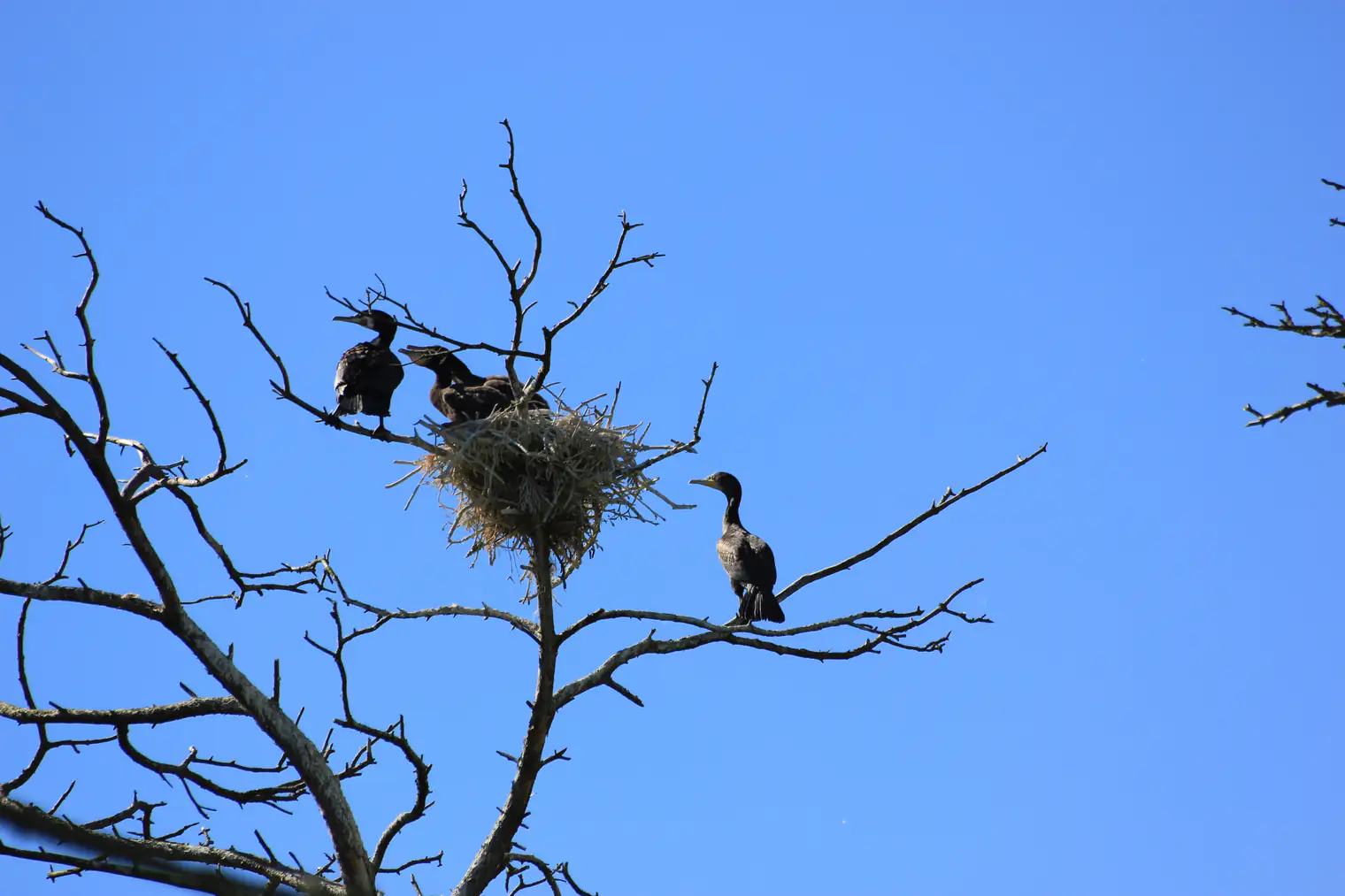
About 3 km south of Juodkrantė, a viewing platform overlooks one of the largest colonies of these birds in Europe: in 2021 more than 3,100 pairs of great cormorants and over 200 pairs of grey herons nested here. The birds arrive from February, and by the end of March the colony is in full swing. Free, at any time.
The Dead Dunes and the buried villages
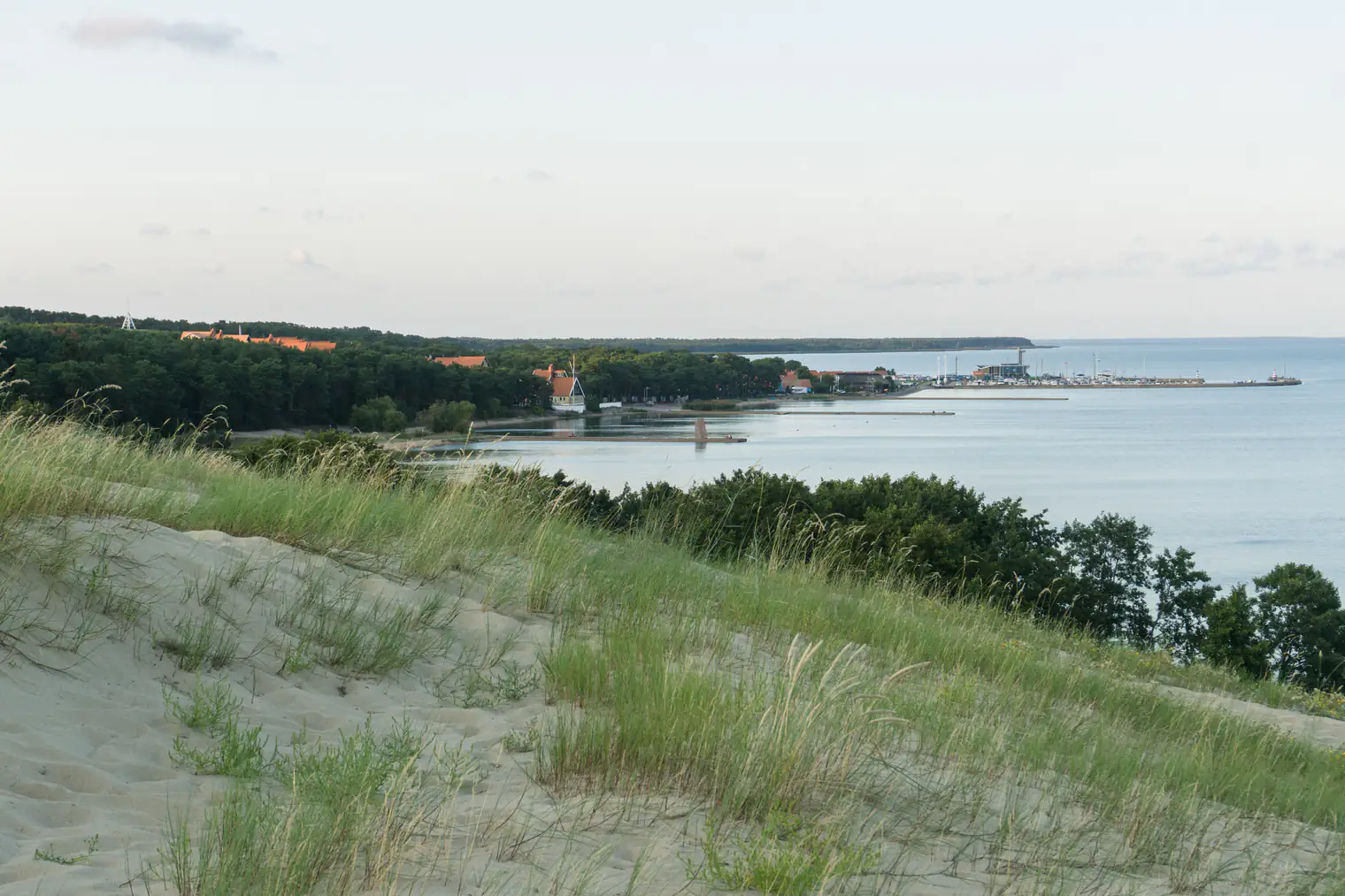
When the spit's forests were cut in the 17th and 18th centuries, the sand began to move – and between 1675 and 1854 it swallowed four villages near today's Nagliai Nature Reserve. The grey, lichen-covered dunes here are called the Dead Dunes. You may enter the reserve only on its 1.1 km educational trail, which starts at a car park around kilometre 32 of the Smiltynė–Nida road and climbs to a ridge with views of both the sea and the lagoon. In the 2026 season (17 April – 18 October) the trail cost €5 for adults, payable by card only; out of season you may walk it freely in daylight.
Further south, Pervalka has a small lighthouse from 1900 standing on its own island in the lagoon – the only lighthouse in Lithuania surrounded by water. Near Preila, the Vecekrugas dune rises to 67 metres, the highest point of the spit.
Nida
Parnidis Dune and its sundial
South of the village, Parnidis Dune rises 52 metres above the sea – locals say its name means “the dune that walked over Nida”. On the top stands a sundial-calendar built in 1995 with a 13.8-metre granite pillar; a hurricane broke it in 1999 and it was restored in 2011. The view takes in the lagoon, the sea and the bare sand stretching south towards Russia. Stay on the marked paths: the east side of the dune is closed to visitors.
Thomas Mann's summer house
The writer fell for Nida in 1929 and built a thatched house on a hill above the lagoon, where his family spent the summers of 1930–1932; locals nicknamed it “Uncle Tom's Cabin”. Part of “Joseph and His Brothers” was written here. Today it is a small museum (€3) and the venue of the Thomas Mann Festival every July.
The fishermen's village
- Fisherman's Ethnographic Homestead (Naglių g. 4) – a fisherman's house of 1927, furnished as around 1900. €2.
- The Lutheran church and cemetery – the church dates from 1888; in the cemetery stand krikštai, carved wooden grave markers shaped like trees, with horse heads for men and hearts for women.
- Curonian Spit History Museum (Pamario g. 53) – how the spit's people lived, including catching crows for food. €2.
- Nida Lighthouse on Urbas Hill – the striped tower of 1953 can be climbed in summer (€5).
Smoked fish for lunch
Smoked fish is the taste of the spit, and most villages have a stall or smokehouse. In Nida, Tik pas Joną on Naglių Street smokes its own fish – go around midday for the best chance of fish still warm from the smokehouse. In Juodkrantė, Žvejonė café and Juodasis kalnas restaurant are known for fish dishes and fish soup. More about local food in our guide to Lithuanian cuisine.
Important: the border and the dunes
- Russia is a few kilometres south of Nida. The southern half of the spit belongs to the Kaliningrad region, and the Nida border checkpoint is temporarily closed. Do not walk south along the beach or the dunes towards the border.
- Stay on the paths. The dunes are fragile and protected; leaving the trails in the reserves can cost a fine of €30–150.
- The national park asks visitors to buy a voluntary €1 ticket that helps maintain the trails.
Frequently asked questions
How do I get from Klaipėda to Nida without a car?
Walk to the Old Ferry, about 15–20 minutes from Bohema, cross to Smiltynė (€1.70 return) and take the bus to Nida (about an hour, €8). There were eight buses a day in October 2026 and up to nineteen in summer.
How much is the Neringa entry fee for cars?
€10 per entry, or €50 from 20 June to 20 August. Pay at the Alksnynė post by card or cash, or in advance via UNIPARK.
Can I visit the Dead Dunes?
Yes, but only on the 1.1 km educational trail of the Nagliai Nature Reserve. In season it costs €5 for adults (card only); out of season you may walk it in daylight for free. Leaving the trail is prohibited.
How long does the drive from Smiltynė to Nida take?
About 49 km, roughly 50–60 minutes without traffic – plus the short crossing on the New Ferry.
Can I walk from Nida to Russia?
No. The border with the Kaliningrad region is a few kilometres south of Nida and the checkpoint is temporarily closed. Stay on marked paths and do not head south along the dunes or the beach.
When is the best time to visit the Curonian Spit?
Late May, June and September: museums and trails are open, the car fee is only €10 and there are fewer people. July and August bring the most buses and ferries, but also the €50 fee and peak crowds.
Further reading
Back in Klaipėda by evening
The spit is a perfect day trip from Bohema: the Old Ferry is a 15–20 minute walk away, and after a long day in the dunes you are back in the Old Town for dinner. Choose your room and plan your Curonian Spit day.
Sources: Smiltynės perkėla – ferry prices, Visit Neringa – buses, Neringa municipality – entry fee, Curonian Spit National Park – Nagliai trail, Neringa Museums, Thomas Mann Museum, UNESCO: Curonian Spit, Border checkpoints directorate. Prices and timetables checked in October 2026. Photos: Karel Frydrýšek, Andrzej Otrębski, Alexey Komarov (CC BY-SA 4.0), Wikimedia Commons.

